Picture Perfect

Powerful women, portraitized.

§

in Archive

EmailTwitterFacebookDigg

Should Michelle Obama be angry because she was declared the world’s most powerful woman? Or, if not angry, maybe, at the very least, a little bit annoyed? I hope that she is. I was — not because I find her lacking in power, but for the same reason that I scrunched my nose at the presence of Maria Shriver, Carla Bruni-Sarkozy, and Sheikha Mozah bint Nasser Al-Missned: first ladies all. They are accomplished, to be sure, but Forbes’ list gave only a nod towards their professional lives and philanthropic activities: In this list their power derives from their husbands’.

For Michelle Obama, that’s the man she called “sweet and pathetic” while she was a guest on The View (June 18, 2008), almost five months before Barack Obama was elected to be our POTUS.

Pathetic is how I’d describe the rush of the women hosting the show as they leapt to do damage control. “Empathetic,” came the chorus, with Whoopi Goldberg spelling out, “E-m-p-a…”

I’m not so sure that empathetic is the right word to describe a husband who leaves his wife alone to deal with an overflowing toilet — as Michelle Obama described in a speech (April 16, 2007), “I was scrambling around to reschedule being at a 9:00 meeting and Barack, love him to death, put on his clothes and he left!”

Maybe if she hadn’t been “scrambling,” he would have changed his schedule?

Ah, well, overflowing toilets are one problem she won’t have to worry about for a long time, not at their current address.

I mention these domestic details because Michelle Obama’s choice as the most powerful woman is linked with her husband’s power. If John McCain had been elected President, would Michelle Obama have been deemed the world’s most powerful woman? No matter how intense a fan you might be of this First Lady, you know the answer.

Putting aside for the moment all questions about (and objections to) the isolation of women in the creation of lists like this — not the 100 most powerful people, but the most powerful women — I’m left staring at the particular composition of this year’s 100: intellectuals, entertainers, business women, and wives. OK, not just wives, but wives of political leaders.

This year’s Forbes list serves as a reminder of how a woman’s position in the world depends on her choice of mate, something that’s easy to forget in 2010.
WomensDay

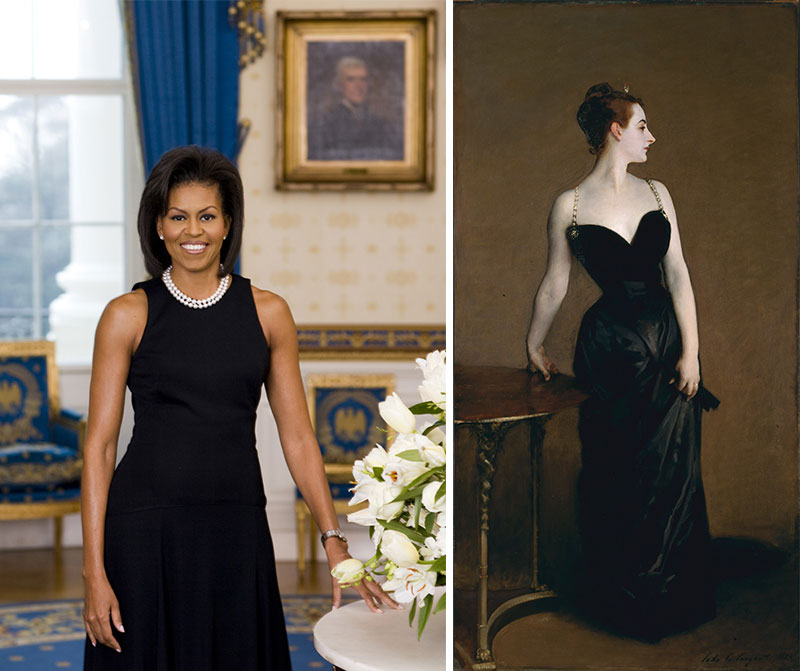
The list’s entry on Michelle Obama is accompanied by her formal portrait by Joyce N. Boghosian, released by the White House a month after the inauguration in 2009. I had barely glanced at it before.

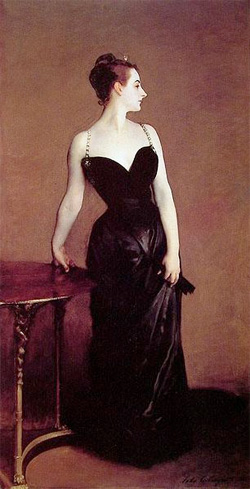
Seeing it again with Forbes’ declaration that the First Lady is the most powerful woman in the world, I became conscious of echoes of the now famous — once infamous — portrait by John Singer Sargent, “Portrait of Madame X” (Madame Pierre Gautreau, 1883-84). Both women are wearing black dresses, both are posed in a contrapposto stance with one hand on a round table. The similarities of the two portraits, however, make the differences between them even more striking, even discounting the busy background of the White House’s Blue Room.

The table in Sargent’s painting is empty and dark; the table in the White House portrait holds a huge bouquet of Casablanca lilies and white tulips. It may be a coincidence, but in the language of flowers the bouquet has an appropriate message. The Casablanca lilies mean “celebration” and the white tulips suggest “worthiness.”

In Sargent’s painting, Madame X’s face is in profile; Michelle Obama faces forward and her gaze meets the viewers. Madame X is not smiling; Michelle Obama has a full smile. Madame X clutches the back of the table, thumb on the table top; Michelle Obama rests the tips of four fingers on the white table top, with her thumb grazing the edge of the table. Madame X stands just beyond the widest part of the table so that although she is not entirely behind it, the table stands in the foreground between her and the viewer, making her more remote; Michelle Obama stands a few inches away from the table about the same distance beyond its widest point as Madame X is in her portrait. As the First Lady reaches out to rest her hand on the table’s surface, it is almost as though she’s touching the table to make a physical connection with something. The fingers of the left hand of Madame X are curled and hold fabric. Michelle Obama’s right arm falls at her side, her fingers in a slight curve.

But in the context of power, the image of Michelle Obama in the official portrait presents, like that of Madame X, a mixed message. Michelle Obama’s head is not at all tilted; moreover, her gaze is direct connects with the viewer. In contrast, her left hand rests on the table, apparently tentative as it connects with something solid, which suggests vulnerability. Her right arm is at her side, seemingly not quite at rest, as though she’s about to raise it to reach out.

What, if anything does this pose mean without some inside knowledge into the conversation between the subject and the photographer? Without that knowledge the buzz has been about the First Lady’s wristwatch (supposedly a Cartier tank), pearls, and sleeveless black dress (Michael Kors), hairstyle, and her manicure, all of which can be deconstructed — and have, even to the shaping of her eyebrows. Her choice of sleeveless dresses in winter received lots of press early in the President’s term.

It’s difficult for me to imagine that a person as sophisticated as Michelle Obama would not have wanted some say about her pose; surely she would have been conscious of all the subtleties of body language within the context of an official photograph. Perhaps even the gap between the dress and her shoulders was a conscious decision as part of a carefully constructed persona, something to make the female viewer want to protect her rather than feel threatened.

The First Lady certainly would not have wanted to project to viewers of the portrait rage of any sort, and certainly not feminist rage, which would be certain to alienate more than half the population. If she had felt any anger over the attribution of power being a function of her being married, it’s better that it be kept out of sight — much as her wedding ring is in this photograph.

Like every woman I have a photo of myself in one of my little black dresses. It’s a black-and-white candid snapshot taken at a party when I was in graduate school. It’s one of my favorite pictures of myself. I’m wearing a sleeveless number that I sometimes wore with a blouse. I’m seated, leaning toward someone across from me, my hair tousled, chin thrust forward, laughing. I don’t remember what was so funny, why I was so happy, or who took the picture. Because I don’t know the facts, I’m free to speculate, to read the photo of myself as I would that of a stranger, a young woman as happy as any young woman can be, happy in youth’s willful, necessary, ignorance of all that lies ahead. • 27 October 2010

EmailTwitterFacebookDigg

A hand glides across a packed bookshelf, dismissing countless volumes in mere blinks. Then, a single cover arrests its journey. That brief halt—the moment a potential reader truly notices—is the crucible.
Romance novel cover art either triumphs with dazzling success or fades into silent oblivion right then.
Consider the sheer scale: American romance publishing brings in more than $1.4 billion each year. And within this colossal market, a book's cover artwork stands as the paramount arbiter of its fate; it decides if a title is plucked from the shelf or simply ignored.
What follows unpacks the calculated design elements, mind-bending psychological tenets, and accepted industry benchmarks. These elements elevate romance novel covers from simple pretty pictures into potent engines of income.
Author, publisher, or graphic artist: grasp this. Forging truly captivating romance cover images directly shapes how readily books are found, what readers anticipate, and the ultimate tally of books sold.
Why Cover Art for Romance Novels Demands Strategic Design
Romance novel cover imagery follows distinct visual codes compared to other literary categories.
This happens because romance enthusiasts base their purchasing choices on particular visual hints. For example, Lauren Landish books comes with unique cover arts and edge colors and design tailored to her romance book genre. These cues hint at the story's overall feel, its level of intimacy, and the emotional journey promised within.
Unlike thrillers, which often underscore enigma, or literary fiction, which champions artistic expression, romance novel covers absolutely must convey genre expectations in fractions of a second.
The typical reader devotes a mere 1.5 to 3 seconds to examine a book cover before choosing whether to delve deeper. In digital marketplaces like Amazon, where thousands of romance titles vie for attention, that viewing window shrinks even more.
Publishers who pour resources into expert romance novel cover designs experience click-through rates from search results that are 20-40% higher than those with generic or shoddy covers. Such outcomes directly translate into algorithmic favoritism for books showing greater reader interaction.
Furthermore, a romance novel's cover cultivates reader confidence.
A skillfully wrought cover proclaims that the publisher or author treats the work with earnestness. This impression often corresponds with a heightened sense of the book's worth—irrespective of the actual manuscript's caliber.
Conversely, clumsy or poorly executed romance novel covers spark immediate doubt, leading prospective readers to assume the narrative itself is equally inferior.
The Psychology of Color in Romance Book Cover Design
The hues chosen for romance novel covers are not merely for decoration; they convey messages.
Distinct color schemes impart specific romance subgenre signals and emotional atmospheres to seasoned romance readers, who navigate this genre with a keen visual discernment.
Red holds sway over passionate, contemporary, and erotic romance. Around 65% of contemporary romance covers showcase red as a dominant hue, frequently paired with lustrous metals such as gold or silver. Red communicates fervor, longing, and immediate emotional stakes. Yet, plain red alone can feel common. The most potent romance novel cover art deploys red in refined pairings—think deep burgundy alongside blush tones, or spirited red accented by navy.
Soft pastels—blush, lavender, cream—point to sweet romance, new adult tales, or lighthearted contemporary narratives. These gentle shades lessen visual intensity and hint at emotional accessibility. Romance novel covers aimed at readers preferring emotional closeness over overt physical descriptions reliably feature pastel backdrops with illustrated or soft-focus visuals.
Deep jewel tones—emerald, sapphire, amethyst—set the stage for historical romance, paranormal stories, or darker modern accounts. These colors suggest opulence, riddle, and sophistication. Publishers creating romance novel cover art in historical or paranormal categories deliberately select jewel-toned palettes precisely because readers have learned to link these colors with those subgenres.
Gold and silver metallics express opulence and premium standing. When incorporated as accent colors or within the lettering on romance novel covers, metallics elevate a book's perceived worth. They entice readers seeking escape and aspirational tales. Metallic elements also boost clarity in thumbnail previews where digital vendors display books.
Typography: How Fonts Communicate Romance Subgenre
The selected typeface for romance novel covers acts as a genre indicator, every bit as significant as color psychology. Serif fonts—particularly elegant, sweeping serif varieties—grace 58% of historical and paranormal romance covers. They evoke classic romantic traditions and literary authenticity. Such fonts tell readers the story values emotional profundity and narrative complexity.
Contemporary and new adult romance often leans heavily on modern sans-serif fonts, frequently presenting geometric exactness or amicable rounded letterforms. This style of lettering in romance novel cover art proclaims approachability, relatability, and current-day settings. Specifically, rounded sans-serif fonts often hint at youthful main characters or emotionally frank stories.
Script and handwritten-style fonts frequently grace romance novel covers, but their presentation demands precision. When poorly executed, script fonts appear amateurish and hinder readability. Expert romance novel cover designs employ script fonts sparingly—typically for subtitles or secondary text—matched with robust sans-serif fonts for the main title. This preserves visual hierarchy and ensures clarity across all viewing dimensions.
The dimensions of type on romance novel covers absolutely must account for legibility in thumbnail views. A book cover appearing splendid at 8x10 inches may become indecipherable when shown as a 1-inch square on a mobile phone.
The most effective romance novel cover art positions the title in letters ample enough to remain clear when scaled down to 150 pixels, ensuring its discovery across all digital storefronts.
Imagery Choices That Define Romance Book Cover Performance
Romance novel cover art utilizes three main visual strategies: illustrated figures, photographic models, and abstract/textural backdrops. Each brings distinct advantages and cultivated reader anticipation.
Illustrated cover art for romance novels provides a creative malleability and an emotional vividness that photography simply cannot match. Illustrated covers dominate paranormal, fantasy, and historical romance realms. This is because illustration can portray supernatural elements, period-appropriate attire, and fantastical environments with complete artistic mastery. Top-tier illustration runs between $1,500 and $5,000, yet it yields singular visual distinction in crowded categories.
Photographic cover art for romance novels, showcasing model photography, holds sway over contemporary, erotic, and new adult romance categories. Approximately 72% of contemporary romance covers feature human models. Professional model photography expresses immediacy and genuine feeling. However, stock photography—which many independent authors adopt to reduce expenses—betrays an amateur production when the same models surface on numerous books, or when photographic quality falls short of professional benchmarks. Investing in bespoke photography or high-grade stock specifically licensed for book covers profoundly alters the perceived quality of the book.
Abstract and textural backgrounds in cover art for romance novels craft visual refinement while keeping production costs down. Gradient fields, watercolor effects, and textural components can cost considerably less than model photography or custom illustration, all while retaining a polished look. This method proves especially apt for contemporary romance, women's fiction, and emotional romance, where the emphasis rests on lettering and atmosphere rather than visualizing characters.
Strategic Positioning of Elements in Cover Art for Romance Novels
Expert romance novel cover designs adhere to particular compositional guidelines. These guidelines amplify visual resonance and uphold genre recognition. The title's placement occupies the upper 60% of the cover, guaranteeing it remains evident when books are lined up spine-out. The author's name appears conspicuously, yet subservient to the title, typically resting in the upper corners or the lower third.
Focal points in romance novel cover art—be they faces, embracing forms, or central imagery—reside in the center-right spot about 60% of the time. This placement mirrors reading tendencies, where eyes naturally drift toward the cover's right side. The most potent romance novel cover art arranges imagery to forge a visual flow from the focal point toward the title, guiding a viewer's gaze along a deliberate trajectory.
Taglines and series details show up in the lower 20% of romance novel cover art. Series branding—including the series title and book number—has become crucial for discovery, as digital algorithms increasingly discern series-related queries. Uniform visual branding across a series of romance novel covers heightens reader familiarity and bolsters series visibility in retailer recommendations.
Genre-Specific Design Standards for Romance Book Covers
Contemporary romance cover art spotlights relatability through clean lettering, vivid backgrounds, and often presents close-up faces or intimate couple images. Minimalist design proves effective in this realm because contemporary romance readers prize authentic emotion over visual embellishment.
Historical romance cover art for romance novels weaves in period-appropriate attire details, classical color schemes, and frequently showcases illustrated figures or carefully styled photography. Decorative design elements—flourishes, ornate borders, vintage typefaces—proclaim historical settings and warrant the premium pricing that historical romance readers anticipate.
Paranormal and fantasy romance cover art for romance novels embraces otherworldly imagery, dramatic lighting, and often features non-human characters or magical components. These covers generally employ darker color palettes and more intricate illustration than other romance subgenres, thereby conveying the expansive worldbuilding and fantastical elements readers expect.
New adult romance cover art bridges the gap between contemporary and paranormal aesthetics, typically displaying young adult-appearing characters in lively poses. These covers often blend softer color palettes and type styles that communicate intense feeling alongside youthful vigor.
Technical Specifications That Determine Cover Success
Romance novel cover art absolutely must fulfill specific technical demands across numerous retail venues.
Amazon KDP insists on a minimum resolution of 300 DPI and particular file measurements: 2,560 x 1,600 pixels for prime viewing.
IngramSpark, which channels books to thousands of stores, mandates a 1/8 inch bleed on all sides to compensate for printing inconsistencies.
Uniform file formatting guarantees that romance novel cover art appears consistently across various sellers. PNG format, with its embedded color profiles, keeps colors true. In contrast, JPEG compression can instigate subtle color shifts, disrupting visual hierarchy.
The divergence between expert color management and haphazard file conversion directly influences how romance novel cover art registers with prospective readers.
Thumbnail optimization stands as a vital technical consideration for romance novel cover art. When scaled to 150x225 pixels (Amazon's standard for mobile display), tiny text becomes unreadable, and delicate color variations vanish.
Scrutinizing romance novel cover art at actual display sizes across devices prior to publication prevents the discovery of legibility failures post-launch.
Practical Implementation: Creating Professional Cover Art for Romance Novels
Authors and publishers weighing custom design against template-based covers ought to gauge their long-term competitive standing. Custom romance novel cover art, ranging from $300 to $2,000, delivers uniqueness and a professional sheen that broadcasts serious publishing intent.
Template-based covers, at $25-150, however, risk looking too much like competitors' books, possibly hindering their discovery.
Collaborating with seasoned designers necessitates clear dialogue regarding genre norms. Supplying sample covers—instances of successful romance novel cover art in your specific subgenre—aids designers in grasping reader expectations and market benchmarks.
The most effective designer briefs outline: primary and secondary colors, the visual approach (illustration, photography, abstract), the desired mood of the typography, and any needs for series continuity.
Testing romance novel cover art before its release dramatically improves outcomes. Presenting mockups in romance reader circles and soliciting feedback reveals whether your cover genuinely conveys its intended genre signals to your actual target readership. This informal vetting catches any discord between authorial aim and reader perception well before investment in printing or permanent digital placement.
Key Takeaways
Professional romance novel cover art balances aesthetic allure with calculated genre communication. It employs color psychology, font hierarchy, and imagery choices to signal precise subgenres and emotional assurances to readers making rapid purchasing decisions. The technical specifications, compositional standards, and psychological principles discussed above elevate romance novel covers from mere decorative elements into powerful, conversion-focused marketing tools. These tools directly affect a book's visibility, its perceived excellence, and its ultimate sales figures.
Regardless of whether one commissions bespoke designs or opts for templates, prioritizing cover quality broadcasts a commitment to professional publishing benchmarks.
Romance readers discern this dedication and reward it with ongoing engagement and enthusiastic recommendations.

§