

I came to the current religion debates a bored man. Started by the
discussions around “intelligent design” and by the books of Dawkins,
Hitchens, Dennett, and Harris (The Four Horsemen), the debate seemed to
pit two irreconcilable views against one another, both vying for an
empty prize. Religion, I gathered, will always have its place, as will
the practices of science and rational inquiry. Perhaps one day some
other arrangement, some other separation of powers, will come about,
but it won’t be any time soon, and it will happen when no one is
looking. It will happen on its own time, with the lazy mastodon
movements of history, which lumbers and rarely sprints.
It has also often struck me in some inchoate way that while the
basic tenets and practices of any specific religion aren’t terribly
impressive, the intellectual dilemma of faith and faithlessness has
something to it. Sure, religion has its ugly side and must strike
everyone in at least one moment of clarity as being something close to
crazy. But, then again, the cleverest of the religious thinkers have
always admitted this, have even tried to turn it into a strength. It is
hard, for instance, not to admire the way that Tertullian, the
Carthaginian Christian philosopher of the second century, stood up to
the fundamental absurdity of his faith and proclaimed “credo quia
absurdum,” “I believe because it is absurd.” Not I believe even though it is absurd, but I believe because
it is absurd. In a more modern variant, the tortured mental gymnastics
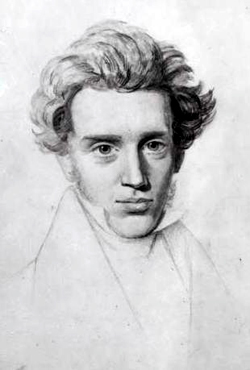
that Kierkegaard goes through in his defense of the story of Abraham
and Isaac goes beyond simplistic apologetics. For Kierkegaard, the
story is powerful because it makes no
sense from any reasonable perspective; it is utterly unthinkable that God would tell Abraham to
sacrifice his son and then wait to see if he’d actually go through with
it. The story is so terrible that it demands attention, and in
demanding of us it gives us access to something more powerful and more
true than what is generally encountered in the world of practical
necessity and contingent decisions that we live in the rest of the
time. It forces a decision.
Indeed, Kierkegaard may be suggesting something profound here, which is that the struggle over belief, the struggle
of faith is more fundamental than the actual possession of it. This is
a more subtle point than that made by the religious dogmatists. It
doesn’t say that religion is fundamental as a set of principles. It
says that the problems of religion are fundamental. In this view, faith
and doubt are intertwined all the way through. More strongly, doubt is
seen to be contingent upon, to be meaningful only alongside, its
antipode faith. For Kierkegaardians, you don’t have doubt without faith
and vice versa. The most powerful, the most meaningful accomplishments
that have emerged from the human swarm, are the result of that
provocative tension, doubt pushing and sliding into faith and then
faith leaping suddenly out of a sea of doubt only to fall again, as all
things do.
This is something that the excellent critic at the New York Sun, Adam Kirsch, touched on in his review of Daniel Dennett’s book Breaking the Spell.
Dennett means to initiate a scientific research project whereby
religion will ultimately be exposed as a product of human biological
history whose relevance to the contemporary situation of human beings
is at least highly questionable. Kirsch thinks that Dennett, in his
scientific project of showing the historical origins of religion and
its biological foundation, has fallen into the “genealogical” fallacy
in which you make the illegitimate move of going from describing
something to judging it. And Kirsch is certainly correct that Dennett
is entirely tone deaf to the way that religion plays an important role
not insofar as it is something to believe or not to believe, but in the
sense that the drama of doubt and faith has informed many of the
central works of Western philosophy, literature, and art. For Kirsch,
even if we can explain the emergence of religious belief from a
scientific standpoint that doesn’t abolish its significance for actual
human beings. He writes:
Mr. Dennett believes that explaining religion in evolutionary terms
will make it less real; that is the whole purpose of his book. But this
is like saying that because water is made of two parts hydrogen and one
part oxygen, it is not really wet; or because the color red represents
a certain frequency of light, it is not really red. To human beings,
the wetness of water, the redness of red, is existentially prior to
their physical composition. Just so, the reality of religious
experience cannot be abolished by explaining it as an adaptation to our
prehistorical environment.
I don’t know if Kirsch is right about this or not. But I don’t think
he knows either. It’s a smart point; it moves me. But there is
something slippery in the analogy. The wetness of water or the redness
of red are not abolished by our knowledge of their physical
composition, partly because there isn’t anything contradictory about
experiencing water as wet and knowing that it is composed of two parts
hydrogen and one part oxygen. It may be weird and beyond explanation
that water “feels” wet, and there is a long debate amongst the
philosophers about the nature of such “qualia,” i.e., the nature of raw
experiences like wetness and redness. But there is still nothing about knowing that water is composed of hydrogen and oxygen
that makes me want to deny that it feels wet to me, or to somehow
prevent it from feeling wet to me now that I know it is just a bunch of atoms. Indeed, I can even go so far as to accept that wetness is simply
the feeling we get, the way we are affected as human beings when two
particular elements combine to form a compound. Again, even if there
is something mysterious going on there, it is a mystery that doesn’t
necessarily play as a contradiction. Feelings are one thing, chemistry
another.
Knowledge and beliefs, however, are much more closely related. What
I know has direct bearing on what I believe. There is a “because”
involved there, even if it is in the seeming absurdity of Tertullian’s
“I believe because it is absurd” or in Kierkegaard’s leap into faith.
You don’t experience water as wet “because” of anything; it simply
happens. No matter how much knowledge you acquire about molecules and
atomic structure you cannot decide to stop feeling water as wet. The
description did not dissolve the experience. But faith is all about
decisions. It is about making choices in response to your experience of
the world. If I know, really know, that religion emerged out of the
same Darwinian processes that have created and shaped other human
practices, then it is going to be difficult for that knowledge not to
seep into my beliefs.
It may be that religious experience is so fundamentally wrapped up
with what it means to be human that no amount of scientific work will
puncture that existential core. But damn it, what if we really could
puncture it? The kind of knowledge that Dennett and Dawkins are after
in exhaustively describing religion and its basis in human evolutionary
development is, one must admit, at least potentially threatening to a
religious conception of the world. And that is what makes the new
religion debates exciting after all. There is something stirring in the
public discourse. We are talking, here, about the possibility of
opening up an entirely new era in the history of human kind. Not a
small thing. It doesn’t lessen one’s respect for how important the
dilemmas of faith have been in human history hitherto to admit that
going forward it might be otherwise. I trust that there will always be
human dilemmas, at least as long as there are humans. But it is always
thrilling to realize that things can be changed, that there is new
terrain to be explored. And as Hitchens in particular points out in his
brutal indictment of the religious mindset, there are some very good
reasons to test that new terrain and to see if we can’t just leave
behind much of the fear and intolerance that seems to go hand in hand
with the question of faith. We failed to kill God the first time. Who’s
to say what might happen the second time around? • 11 October 2007